Agile & Scrum in Practice: What Really Matters Beyond the Framework
Yacine Ouardi
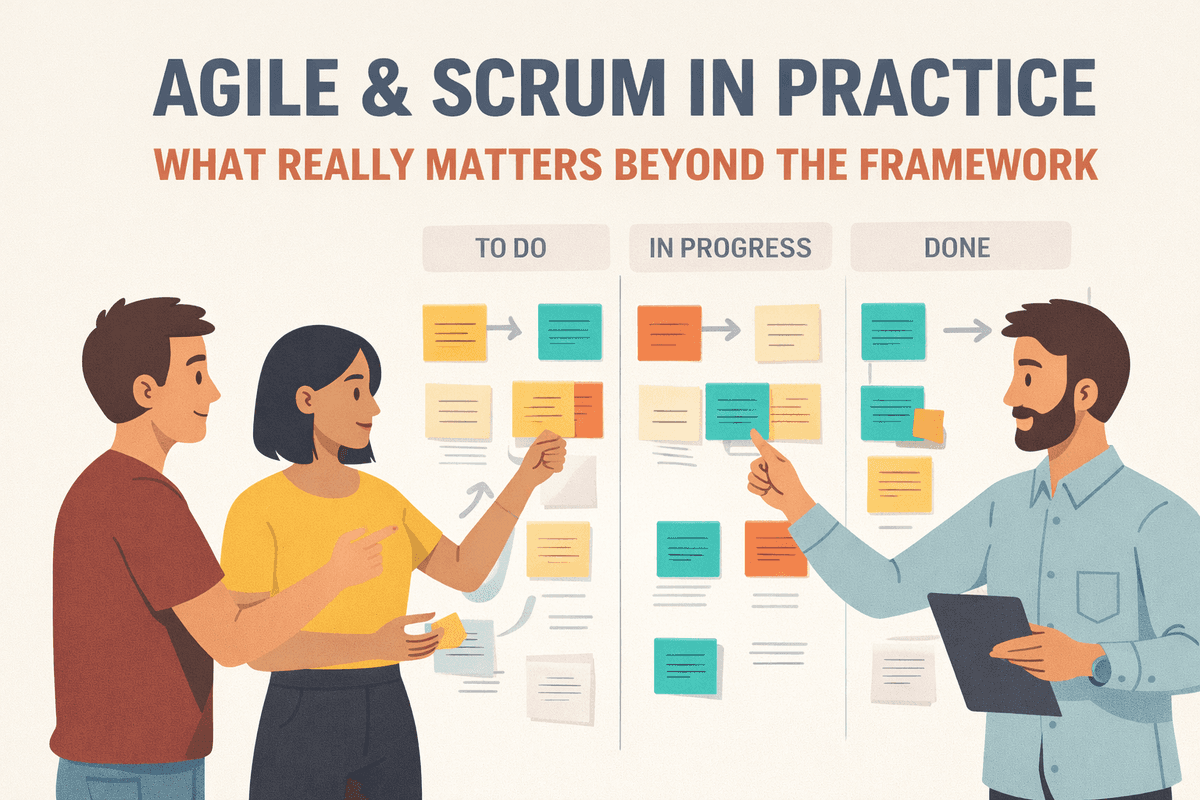
Four Days of Scrum Training — What Agile Actually Brings to a Team (Beyond the Buzzwords)
Agile and Scrum are often talked about as if everyone already understands them.
In reality, many teams practice fragments of Agile without ever fully grasping why those practices exist or how they fit together.
Recently, my company organized a formal, four-day Agile/Scrum training led by a dedicated trainer. What made it valuable wasn’t the introduction of new rituals — it was the structure, clarity, and intent behind them.
Agile Is Not a Toolset — It’s a System
One of the most important clarifications from the training was this:
Scrum only works when its parts support each other.
Roles, ceremonies (events), story points, backlog refinement, Definition of Ready (DoR), and Definition of Done (DoD) are not isolated practices. They exist to solve very specific problems:
- Roles clarify responsibility and ownership
- Events create regular feedback loops
- Estimation forces shared understanding
- Backlog refinement reduces uncertainty before work starts
- DoR and DoD protect the team from ambiguity
When teams “do Scrum” without understanding this system, Agile quickly becomes performative — meetings without impact, estimates without trust, and sprints without direction.
Why Scrum Cares So Much About Clarity
A recurring theme throughout the training was requirements clarity.
Scrum doesn’t assume that requirements are perfect — it assumes they are dangerous when unclear.
That’s why Scrum insists on:
- Refinement before commitment
- Acceptance criteria before implementation
- A clear DoR before a story enters a sprint
In practice, this doesn’t slow teams down.
It prevents invisible rework, misaligned expectations, and late-stage surprises.
Most delivery issues aren’t caused by poor execution — they’re caused by starting work too early, with too many unknowns.
Scrum vs Reality: Urgency Still Exists
A common criticism of Scrum is that it doesn’t account for urgency.
The training addressed this directly.
Real projects include:
- Urgent requests
- Last-minute changes
- Stakeholder pressure
Scrum doesn’t deny this reality — it makes the trade-offs explicit.
When something urgent interrupts a sprint, Scrum forces the team to ask:
- What gets deprioritized?
- What risk are we accepting?
- Are we protecting quality or just moving fast?
This transparency is one of Scrum’s biggest strengths.
It replaces silent chaos with visible decisions.
Making Work Visible (Especially Frontend Work)
Another often overlooked benefit of Scrum is work visibility.
Through:
- Story points
- Sprint goals
- DoD
- Sprint reviews
Work becomes:
- Easier to track
- Easier to explain
- Easier to evaluate
This is particularly important for frontend and product-facing work, where complexity is often underestimated. Scrum provides a shared framework to discuss scope, effort, and completeness — not opinions.
Visibility isn’t about control.
It’s about alignment.
Why This Training Mattered
What made this Agile/Scrum training valuable wasn’t the content alone — it was the shared understanding it created across the team.
Agile works best when:
- Everyone understands why practices exist
- Teams know when to adapt instead of blindly following
- Process supports delivery, not the other way around
Scrum doesn’t promise predictability.
It promises early feedback, clearer decisions, and better conversations.
In challenging work environments, that’s not a luxury — it’s a necessity.
Final Thought
Agile isn’t about moving fast.
It’s about reducing uncertainty before it becomes expensive.
Understanding Scrum properly doesn’t make work easier —
it makes problems visible sooner, when they’re still solvable.
And that’s exactly why it matters.